Miyoga Must Read #3 – Fearless in Tibet

Fearless in Tibet – The Life of the Mystic Tertön Sogyal

Matteo Pistono

Very rarely but from time to time, I pick up a book and know that it is a living thing, not mere pages and print. This book is alive and will be a dear companion for the seeker walking along the razor edge. It tells of the life of Tertön Sogyal but is more than a re-telling, it is an induction into the ancient spiritual practices of the Tibetan lineage. 
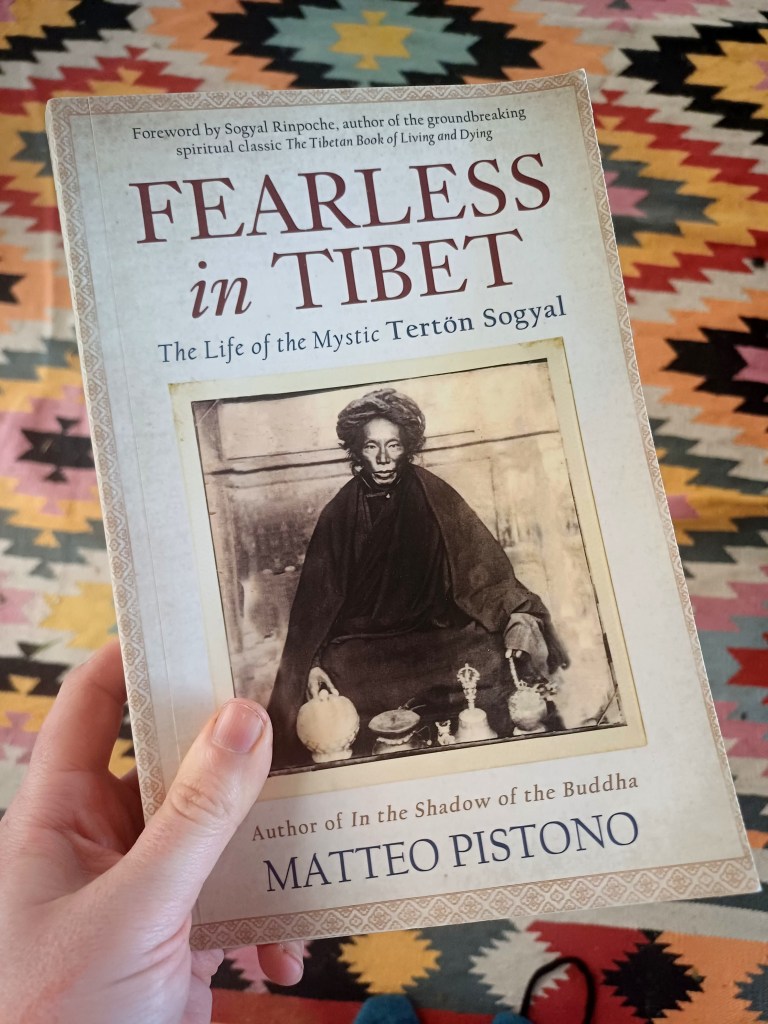
Often when I hear of the mystics of Tibet it feels to me as though these lives are from another world. What Matteo Pistano achieves with “Fearless in Tibet – The Life of the Mystic Tertön Sogyal” is to bring this life of a realised master and his insight of spiritual awakening into this world and make it relevant for todays climate of political, cultural and global upheaval. 

The level of research conducted by the author goes beyond academia to complete devotion to his subject. It is the kind of text that emerges from lifetimes, not years of what one could call love, but moves far beyond, to a point of unification and understanding of the treasure a realised teacher is when they can reveal our true nature. At a certain point, it is no longer a matter of love that keeps one connected to the guru, but a reverence and respect for the journey they have endeavoured for our benefit.

Guru of the thirteenth Dalai Lama, Tertön Sogyal or Lerab Lingpa, was instrumental in guiding peace between China and Tibet at the end of the 19th and beginning of the 20th century, prior to the invasion of Tibet. It speaks of a time when forces beyond geo-political drama were strongly at play and is a reminder of the multi-dimensional reality of relationships between people, cultures and nations. 

The forward written by Sogyal Rinpoche (author of the Tibetan Book of Living and Dying) who is considered the current day incarnation of Tertön Sogyal reads, ‘I believe I must have first heard about Tertön Sogyal from my own beloved master, Jamyang Khyentse Chökyi Lodrö, who raised me as his one, gave me the name “Sogyal” and recognized me as an incarnation of Lerab Lingpa… As time went by, I became increasingly aware of and inspired by Tertön Sogyal’s revelations, so much so that they became the cornerstone of my life, my practice, and my teachings…”

At times while reading the details of this account, I questioned, how could Pistono possibly have known these intricacies occurred? And then decided to surrender to the narrative and be taken on the journey. There is no way Pistono could have recounted the spiritual awakening and meditation in such details without having had his own deep journey of dedicated practice and insight. The retelling is done with such intimacy that through the reading of this book, I truly believed I was there, with Tertön Sogyal on all dimensions, beyond time:

“…When he looked again at the stone treasure casket on the shrine, he saw that it had opened by itself, revealing five compartments. Inside each compartment was a rolled golden parchment with dakini script. Like steam rising from a boiling kettle spout, wrathful and peaceful deities began to emanate from the paper and took up their place in the form of a mandala in the space before Sogyal…” (p. 42)

This style of biography reminded me of The Agony and the Ecstasy by Irving Stone which I had read many years ago (a retelling of the life of Michaelangelo, explored here https://www.youtube.com/watch?v=dlhn_Kxgm8g). These authors are truly rare treasures and in the age of ChatGPT where the authenticity of devotional research and retelling of history through the human heart is at serious threat, I appreciate them with a burning fire. The importance of these teachings resonate today more than ever:

Padmasambhava told Tertön Sogyal in a vision, “In these degenerate times, when evil forces are strong, obstacles will come like unending waves. In actuality, the negative forces will come from within your own rangs and seek to destroy you. There will be a time when students receive teachings, even placing their guru’s feet upon their crown, and then backbite their teacher straight away” (p. 98)

The text is clearly deeply researched, with a fair majority of the book dedicated to references, index and footnoting, making it an excellent starting point for any historian. However it is important to allow your mind to be suspended. To allow a reality to unfold that moves between lifetimes, between dimensions and so far beyond the physical it becomes a narrow scaffold that is a mere hint of the worlds that live beyond our narrow human perception of mind. Time and space cease to hold their spell in moments of Terma revelations such as:

…The scroll’s secret script was a mnemonic device that spurred Sogyal’s memory of receiving The Most Secret Wrathful Vajrakilaya from Padmasambhava and allowed him to reveal it in the present. As if the lock on a treasure chest were clicked open with the turning of a key, the teaching flowed from Sogyal’s mind… (p 43)

The life of Sogyal underscores the power of spiritual practice, true insight and high frequency awareness during times of political conflict and culutural unrest. A recent film I watched “Project Mincemeat” (also highly recommend) echoes this theme of nuances of dualism and conflict. On the high-octane spiritual path (as opposed to the Yoga and pilates pill too eagerly prescribed today), the greatest challenges will always be from within. Within your self,  your family, your friends, your colleagues. Every lesson you require is no further away than the tip of your nose. This book provided a wonderful companion and guide to have the courage to go deeper. 
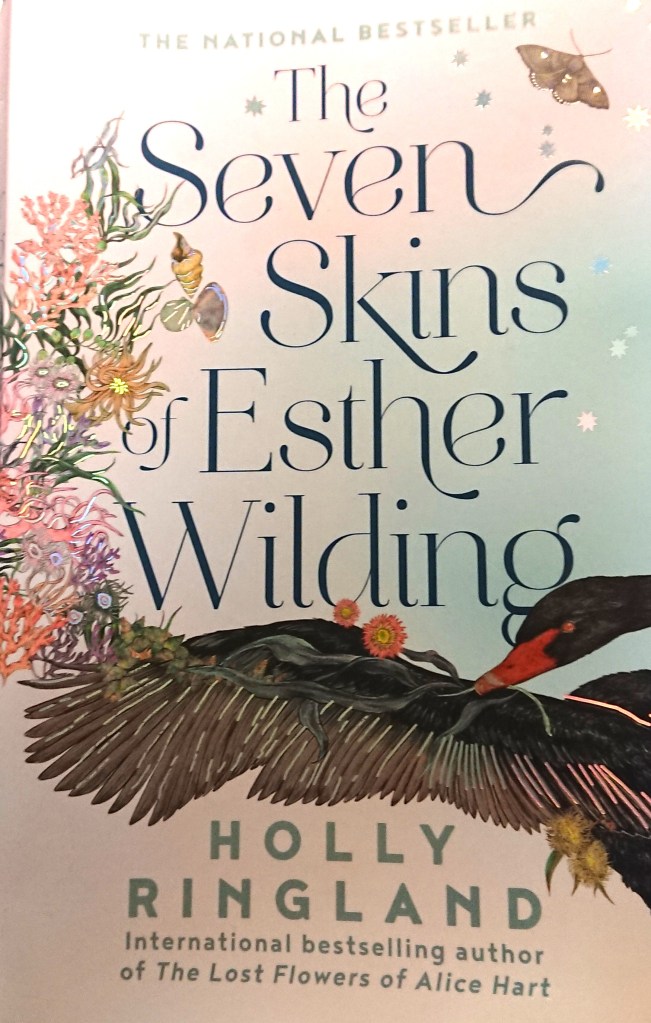
Miyoga Must Read #2 – The Seven Skins of Esther Wilding

Its been a while since I have inhaled a book. And this one was a fresh, deep breath of sea and smoky air.

Holly Ringland wrote The Seven Skins of Esther Wilding at the onset of Covid-19. It fascinates me in hindsight, what a surge of creativity was occurring under the surface of stillness and lockdown. A frenzy of discovery, beauty, pain and the need to deep dive into our shared human experience was felt globally – this is one of the pearls that emerged.

Having just finished Stolen Focus, I was reflecting as I read on Johann Hari’s observation about the importance of reading fiction not only to improve and reclaim our focus but also to deepen our sense of compassion, self-awareness and collective understanding of universal themes such as grief, loss and heart break.

I emerged from this book wrapped in a cloak of my own travels, loss and personal journey that was much richer and more comforting than before meeting and merging with these characters. Esther’s self-loathing and destructive tendencies were first felt with the kind of discomfort that forced me to put the book down and inwardly plea to the character – would you pull yourself together?? But as we get to know her in depth – a quite understanding emerges. It reminds me of a documentary I watched recently on Shakespeare by Ethan Hawke ‘Shakespeare Uncovered‘. He interviewed an academic in his preparation to play Macbeth and in the interview the expert observed that Shakespeare did not present his characters to the audience and declare “look upon (and judge) this example of a life gone wrong” (I paraphrase), but rather he presented the varied and many facets of humanity and what we have come to know as ‘failures’ and let us deeply understand that, me too, I could also reach the depths of that despair given the potent cocktail of pain endured by his protagonists. The delicacy and respect with which Ringland treats both Esther and her sister Aura speaks of a wisdom that is the hallmark of a truly wonderful author. This deep respect also came through from Ringland’s research and portrayal of palapa mani, the language of Pakana people of Lutruwita, Tasmania. It was such a pleasure to see these words on the page and shape them in my mind.

This book grappled with that delicate space between tradition, colonisation and the importance of belonging, not only to a place but to a people and ultimately to your Self. It is a timely read and one that I hope heralds the beginning of more nuanced portrayals of Australian history.

This was perhaps the first book I have read where the coming of age time space precisely fit my own and I considered how my contemporaries are now hitting their straps as they hit the sweet spot of mid age, which when lived with a creative lens makes the wrinkles and sags worth the subtle judgement because they are what make truly good stories.

Another echo in the back of my mind as I read this book was a recent episode of The First Inventors which explored kinship systems of the Indigenous Australian nations’ which were a truly remarkable multi-dimensional system established not just to ensure diversity in the genetic pool of their societies but also to create a sustainable balance of resources through deep connectivity with land, animal and plant kingdoms. Ringland managers to weave an understanding of this that moves deeply in culture and beyond it to a universal space, held together through the custodianship and conservation of cultural identity. An absolute must read!

Miyoga Must Read #1 – Stolen Focus

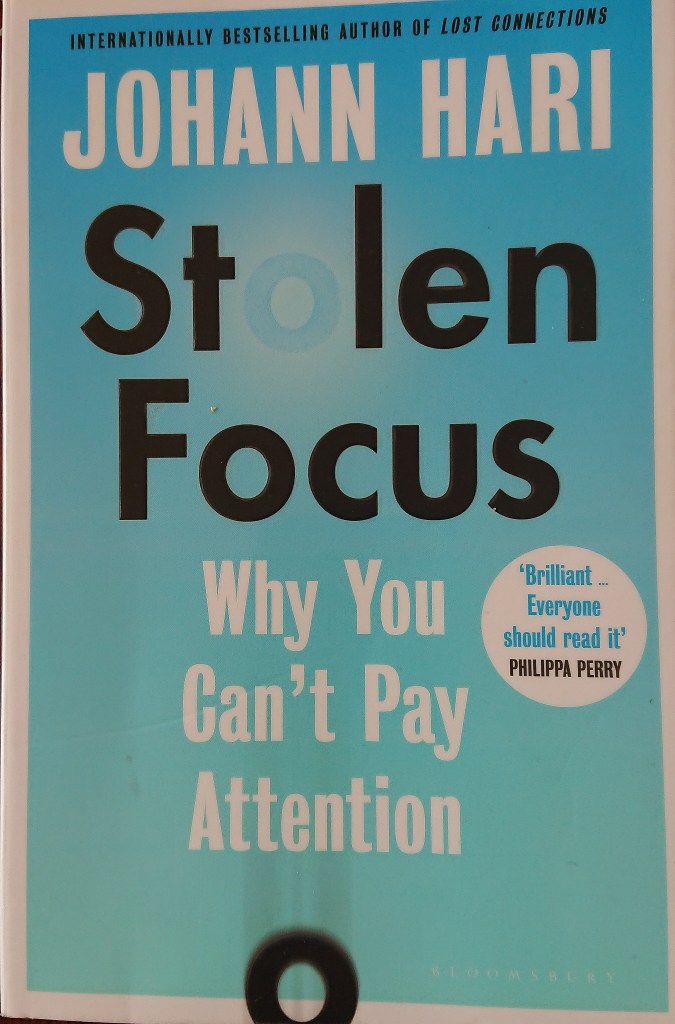
Johann Hari – Stolen Focus

‘Stolen Focus – Why You Can’t Pay Attention’ is the first book for Miyoga Must Reads for a few reasons.

The Covid hang-over is very real, particularly for those who faced extensive lock-downs and ever since it seems the epidemic of stollen focus has been hot on the heals of the Covid-19 virus.

What fascinated me about Hari’s deep dive into the reasons behind our loss of attention was that it is not limited to any one factor, but rather a perfect storm of elements which we are living out, largely unspoken and unaddressed.

For the Yogini in me this affects everything. Choosing to live by a premise that everything is meditation and watching my focus become more fuzzy by the day is deeply concerning. So to find some answers came with some relief.

The first item on Hari’s agenda was smart phones, social media and the internet. After getting a few chapters in and glimpsing behind the curtain to the workings behind how we are being engineered for “surveillance capitalism” I felt such a feeling of disgust in the pit of my stomach that I pulled my phone up and immediately removed the social media apps. Its been several months and after a period of detox, I have stopped the habit of reaching for my phone and scrolling through curated advertisements designed for no other purpose than to keep me locked in.

Its been a few months actually just to finish this book. The irony was not lost as I put it down, picked it up, put it down for several weeks and picked it up again. There was a strong pull to sit with the discomfort of loosing my focus and at the same time a sense of wanting to stay in the dark and therefor not feel the need to do anything about it. Needing to return this book to the library after several re-borrows was the final push I needed to get to the end. It isn’t an easy read, it rather felt like watching a global train wreck that I had no ability to alter, but it is an essential read.

Towards the end of the book Hari speaks about activism and what we can achieve as a collective to reclaim our ability to have the space, conditions and liberty of our own attention. He argues that while individual gestures like switching off your phone helps, they won’t get to the root cause. Hari goes into detail about the mechanism behind blame and corruption and sites several examples including the lead poisoning historical case where parents (particularly indigenous parents) were told they and their children were to blame for the lead poisoning faced by their community. We have since uncovered the truth, however this period of uncertainty and scapegoating is occurring now when it comes to the hijacking of our attention.

That feeling of guilt after moments of your life are swallowed up scrolling only feed into the system of distraction which is steeling, what for the yogi is the greatest power of all – our attention. Our ability to transmute reality, to take control of our destiny with the guidance of principles such as the Yamas and Niyamas. And the answer is not a strict diet of no internet, socials or screen time. It is more nuanced. We need to remember the value of our attention and have the will power and strength to direct it to our individual calling – rather than a collective cacophony of consumerism.

Recent examples of tangible change include the law passed that Apple must use universal charging ports. I was thrilled to see the first one recently – though small, this is a huge win and speaks of the power of saying NO so that we get the option to say YES when it feels right. And more recently the Australia high court has ruled that it is unconstitutional to tax owners of electronic vehicles who are making the switch to reduce Co2s to our planet. After a week of dismay after the referendum results this came with some small hope.

Hari examines the economic structures that we are trapped in for continuous and unceasing growth and looks to this for understanding around why time seems to be speeding up at an alarming rate. Bigger, better, stronger, faster is the heart beat of our world and yet it is killing us and everything this planet supports right before our eyes, so it is no wonder that levels of anxiety are through the roof and what do we need at times of crisis? A panacea in the form of distraction.

What I took away from this detailed account was firstly a sadness. What is at stake is the most precious gem in the universe – our consciousness.

Where is your breath right now? How is your conscious awareness connected to the space around and within you? These are the tools of transmutation, of freedom, joy, liberty of everything it means to be human, to be sentient.

It is a must read, though not an easy one (and available on audio book if getting to it that way is a more realistic option) . For more info visit:

The Thank You Song

It has been a year of everything imaginable – we offer this song of gratitude to all.

Words: Grazie (Italian)

Effharisto (Greek)

Sheh Sheh (Mandarin Chinese)

Merci (French) Danke (German)

Spaciba (Russian)

Ari-gato-o (Japanese)

Grasias (Spanish)

Mahalo (Hawaiian)

Nandri (Tamil)

Dorje (Cantonese)

Terima Kasih (Indonesian)

Obrigado (Portuguese)

Manana (Pashto)

Diakuju (Ukrainian)

Wado (Cherokee)

Sukran (Arabic)

Sipas Dikim (Kurdish)

Kersernerm (Hungarian)

Shukria (Urdu)

Komsamnida (Korean)

Danyabada (Bengali) T

ak (Swedish)

Thu je Che (Tibetan)

Multumesc (Romanian)

Kii Toss (Danish)

Vinaka (Fijian)

Asante (Swahili)

Toda (Hebrew)

Khawp (Cup)

Kuhn (Thai)

Paldies (Latrvian)

Aida (Estonian)

Faleminderit (Albanian)

Salamat (Tagalog)

Hvala vam (Serbo Croatian)

Sulpayki (Peruvian Qechua)

Khublei (Khasi, Indian – Bangladesh)

Orkun (Cambodian)

Dyekooyih (Czech)

Mahadsanid (Somali)

Thank you

Blessed are we

Good Tidings to one and all

No copyright – please share with love.

#miyogaclub #noel #christmas #languages #thankyou #gratitude